Introduction
Walk into any engineering office and mention 'steel,' and you'll likely hear a dozen different grade numbers: C45, 4140, 1.4301, 316... What do they all mean? Why are there so many, and how do you choose the right one?
Steel is the backbone of modern manufacturing, but its complexity can be overwhelming. With thousands of grades, multiple nomenclature systems, and countless application-specific requirements, selecting the appropriate steel grade is both an art and a science.
Quick Fact
There are over 3,500 different grades of steel globally, each optimized for specific applications, environments, and performance requirements.
This comprehensive guide will demystify steel grades, explain the major categories, decode nomenclature systems, and provide practical guidance for selecting the right material for your application.
What is Steel?
At its core, steel is an alloy of iron and carbon, typically containing 0.02% to 2.0% carbon by weight. But modern steels are far more complex, incorporating various alloying elements to achieve specific properties.
Basic Composition
- Iron (Fe): The primary element, typically 98-99% in most steels
- Carbon (C): The key alloying element, 0.02-2.0%; dramatically affects strength and hardness
- Alloying Elements: Chromium, nickel, molybdenum, manganese, silicon, and others added for specific properties
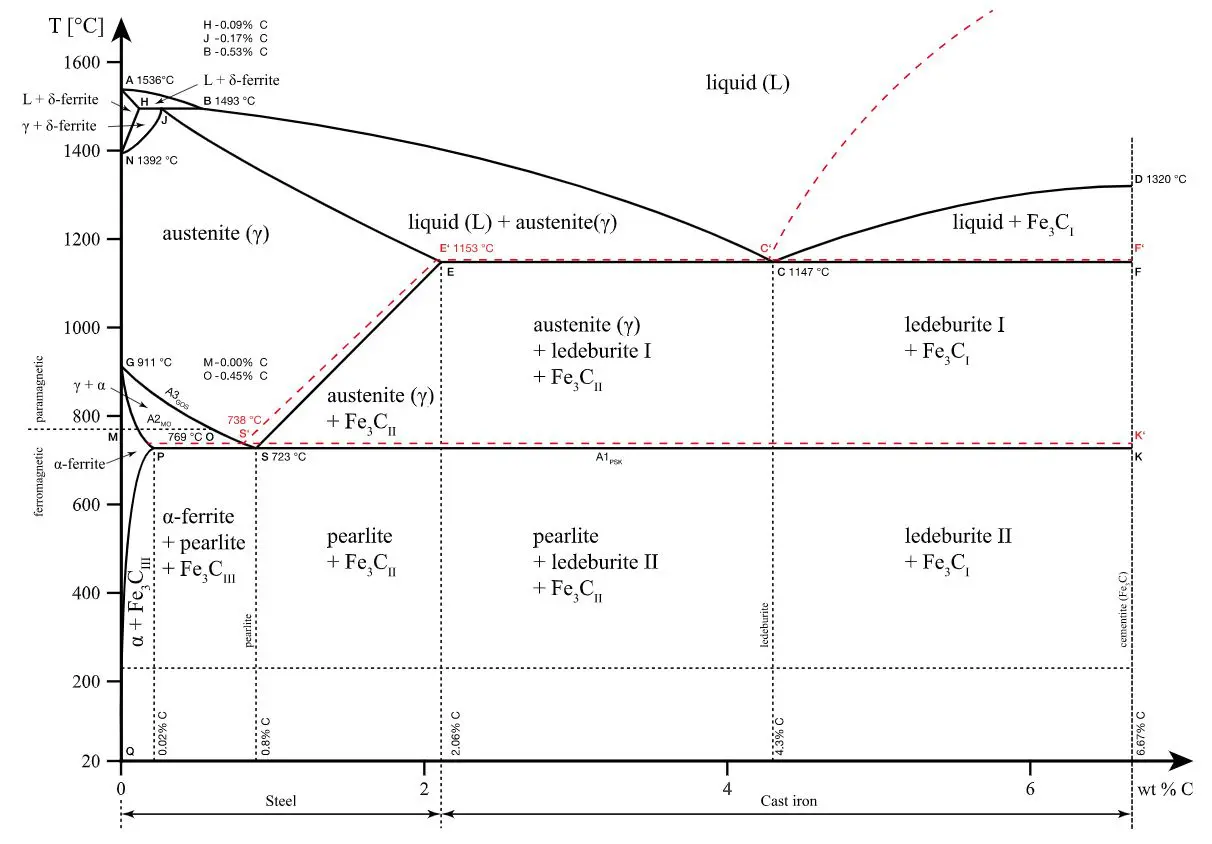
Iron–carbon phase diagram: phases, transformation points and the carbon range covered by steels
Understanding the Iron-Carbon Phase Diagram
The phase diagram above shows how iron and carbon interact at different temperatures – a fundamental tool for understanding steel grades:
- X-Axis (Carbon Content): Shows carbon percentage from 0% to 6.67%. Steel contains 0-2% carbon; beyond that, it's classified as cast iron.
- Y-Axis (Temperature): Shows temperatures from room temperature to over 1500°C and the phase transitions during different heat treatments.
- Steel Zone (0-2% C): The left portion of the diagram shows the steel range. Low-carbon steels (<0.3%) are soft and weldable, high-carbon steels (0.6-2%) are hard but more brittle.
- Phases: Ferrite (α) is soft and magnetic, Austenite (γ) is stable at high temperatures, Pearlite is a mixture of ferrite and cementite with good strength.
This diagram explains why heat treatments like hardening, tempering, and normalizing work – they utilize phase transformations to achieve desired properties.
Why So Many Grades?
Different applications demand different properties. Steel grades are engineered to optimize specific characteristics for particular use cases:
Structural Applications
Need strength and weldability (building frames, bridges)
Mechanical Components
Require hardness and fatigue resistance (gears, shafts)
Corrosion Resistance
Essential for chemical, marine, or food processing environments
High-Temperature Service
Demand creep resistance and oxidation resistance (boilers, turbines)
Major Steel Categories
Steel grades are broadly classified by carbon content and alloying elements. Let's explore each category in detail.
Low Carbon Steels (< 0.3% C)
Definition
Also called 'mild steel,' containing less than 0.3% carbon. These are the most common and economical steels.
Key Properties
- Tensile Strength: Moderate (400-500 MPa typical)
- Ductility: Excellent - easy to form, bend, and weld
- Weldability: Excellent - no preheating required
- Machinability: Good to fair
- Hardening Capability: Cannot be significantly hardened by heat treatment
Common Grades
| Grade | Carbon % | Typical Applications |
|---|---|---|
| C15 / 1015 | 0.15% | Low-stress parts, general fabrication |
| C22 / 1022 | 0.22% | Shafts, pins, construction parts |
| St37-2 / A36 | ~0.20% | Structural steel, general construction, frames |
Typical Applications
Building structures, automotive body panels, wire products, nuts and bolts, general fabrication.
Medium Carbon Steels (0.3-0.6% C)
Definition
The workhorse of mechanical engineering, balancing strength and ductility.
Key Properties
- Tensile Strength: Good (600-800 MPa typical)
- Hardening Capability: Can be heat treated for significant hardening
- Weldability: Fair - preheating often recommended
- Balance: Good compromise between strength and ductility
Common Grades
| Grade | Carbon % | Typical Applications |
|---|---|---|
| C35 / 1035 | 0.35% | General machinery parts, crankshafts |
| C45 / 1045 | 0.45% | Shafts, gears, bolts, studs (workhorse grade) |
| 42CrMo4 / 4140 | 0.42% | High-strength shafts, gears, critical components |
Typical Applications
Shafts, gears, connecting rods, crankshafts, bolts, studs, machinery parts.
High Carbon Steels (0.6-2.0% C)
Definition
Maximum hardness and wear resistance, but reduced ductility.
Key Properties
- Hardness: Excellent when heat treated (55-65 HRC achievable)
- Wear Resistance: Excellent
- Brittleness: Can be brittle if not properly tempered
- Weldability: Poor - special procedures required
Common Grades
| Grade | Carbon % | Typical Applications |
|---|---|---|
| C60 / 1060 | 0.60% | Springs, high-strength wire |
| C80 / 1080 | 0.80% | Cutting tools, punches, dies |
| 100Cr6 / 52100 | 1.00% | Bearing races, balls, precision rolling elements |
Typical Applications
Springs, cutting tools, bearings, dies, high-strength wire.
Stainless Steels (> 10.5% Cr)
Definition
Defined by a minimum of 10.5% chromium content, which forms a protective oxide layer providing corrosion resistance.
Main Types
Austenitic (300 Series)
Examples: 304, 316, 321
Non-magnetic, excellent corrosion resistance, cannot be hardened by heat treatment. Most common stainless family.
Ferritic (400 Series)
Examples: 430, 409
Magnetic, good corrosion resistance, less expensive than austenitic.
Martensitic (400 Series)
Examples: 410, 420, 440C
Magnetic, hardenable by heat treatment, moderate corrosion resistance.
Duplex
Examples: 2205, 2507
Combination of austenitic and ferritic structures, excellent strength and corrosion resistance.
Most Common Grades
| Grade | Type | Typical Applications |
|---|---|---|
| 1.4301 / 304 | Austenitic | Food equipment, chemical processing, general purpose |
| 1.4401 / 316 | Austenitic | Marine, chemical, pharmaceutical (superior corrosion resistance) |
| 1.4462 / 2205 | Duplex | Oil & gas, chemical processing, high-strength applications |
High Alloy Steels (Specialized Grades)
These are specialized steels with high percentages of alloying elements, engineered for extreme conditions:
- Tool Steels (H13, D2, etc.): Extreme hardness and wear resistance for tooling
- Maraging Steels: Ultra-high strength combined with toughness (aerospace)
- High-Temperature Alloys (Inconel, etc.): Maintain strength at extreme temperatures
These specialized grades warrant their own detailed article - stay tuned!
Steel Properties Explained
Understanding key material properties helps in selecting the right grade. Here's what matters most:
Tensile Strength
The maximum stress a material can withstand while being stretched before breaking. Measured in MPa or PSI.
Affected by: Carbon content, alloying elements, heat treatment
Hardness
Resistance to indentation, wear, and deformation. Measured on Rockwell (HRC), Brinell (HB), or Vickers (HV) scales.
Affected by: Carbon content primarily, plus heat treatment
Ductility & Toughness
Ability to deform without breaking (ductility) and absorb energy before fracture (toughness).
Trade-off: Generally inverse relationship with hardness
Weldability
Ease of welding without cracking or requiring special procedures.
Rule of Thumb: Higher carbon = harder to weld
Machinability
Ease of cutting, drilling, and machining.
Best: Low carbon and free-machining grades (11XX series)
Corrosion Resistance
Ability to resist rust and chemical attack.
Key: Stainless steels with high chromium content
Heat Treatment & Its Impact on Properties
Heat treatment can transform steel properties dramatically. The same grade can perform very differently depending on its heat treatment.
Critical Understanding
A C45 shaft 'as-forged' at 600 MPa tensile strength can be quenched and tempered to achieve 900+ MPa - nearly 50% stronger from the same material!
Heat Treatment Processes
Normalizing
Process: Heat above transformation temperature, air cool
Effect: Refines grain structure, improves uniformity
Typical Use: Post-forging to relieve stresses and improve machinability
Annealing
Process: Heat and very slow cool (often in furnace)
Effect: Softens material, maximizes ductility
Typical Use: Before machining or forming operations
Quenching & Hardening
Process: Heat above transformation, rapid cool (water/oil)
Effect: Maximizes hardness (but also brittleness)
Typical Use: For parts requiring high wear resistance
Tempering
Process: Reheat hardened steel to intermediate temperature
Effect: Reduces brittleness, improves toughness while maintaining good hardness
Typical Use: Almost always follows quenching; 'Q&T' is the standard combo
Case Hardening (Carburizing)
Process: Diffuse carbon into surface, then quench
Effect: Hard, wear-resistant surface with tough core
Typical Use: Gears, cam shafts, bearing surfaces
Stress Relief
Process: Moderate heating (550-650°C), slow cool
Effect: Relieves internal stresses without major property changes
Typical Use: Post-welding, after machining
Property Changes with Heat Treatment
| Grade | As-Forged / Normalized | Normalized | Quenched & Tempered |
|---|---|---|---|
| C45 / 1045 | ~600 MPa, 180 HB | ~620 MPa, 190 HB | 900+ MPa, 280+ HB |
| 42CrMo4 / 4140 | ~700 MPa, 210 HB | ~750 MPa, 230 HB | 1100+ MPa, 320+ HB |
| 34CrNiMo6 / 4340 | ~800 MPa, 240 HB | ~850 MPa, 260 HB | 1200+ MPa, 360+ HB |
Cost Considerations: Making Smart Material Choices
Material cost varies significantly by grade and availability. Understanding cost structures helps optimize project budgets.
Relative Price Ranges (Approximate)
| Steel Category | Examples | Relative Cost | Typical Price (Europe) |
|---|---|---|---|
| Low Carbon Steel | St37, C15, C22 | 1.0x | €600-900/ton |
| Medium Carbon Steel | C45, 1045 | 1.2-1.4x | €720-1,260/ton |
| Alloy Steel (Cr-Mo) | 42CrMo4, 4140 | 1.5-2.0x | €900-1,800/ton |
| Stainless (304/316) | 304, 316 | 3.0-4.0x | €1,800-3,600/ton |
| Duplex Stainless | 2205 Duplex | 4.5-6.0x | €2,700-5,400/ton |
| Specialty/Tool Steels | Tool steels, super alloys | 8.0-20x+ | €4,800-18,000+/ton |
Hidden Cost Factors
- Machining Costs: Harder steels = longer machining time and tool wear
- Heat Treatment: Q&T adds €50-200/part depending on size and complexity
- Scrap Rate: Higher for difficult-to-machine or brittle materials
- Lead Time Impact: Exotic grades may require long lead times and minimum orders
- Minimum Order Quantities: Specialty grades often have high MOQs from mills
Cost Optimization Strategies
Sometimes a more expensive material grade results in lower total cost:
| Scenario | Cheaper Grade | Better Value Grade | Why Better? |
|---|---|---|---|
| High-strength shaft | C45 Q&T | 42CrMo4 N+T | Better hardenability, less machining time, more reliable Q&T results |
| Mild corrosion environment | 316 Stainless | C45 + Coating | Carbon steel is 1/3 the cost; coating is cheaper than stainless |
| Moderately loaded gear | Tool Steel | 42CrMo4 Q&T | Tool steel is overkill; 42CrMo4 provides adequate properties at lower cost |
Industry-Specific Steel Recommendations
Different industries have evolved preferred steel grades based on their unique requirements. Here's what works where:
Automotive Industry
Common Grades:
- 16MnCr5 / 5115 – Gears, transmission parts (case-hardened)
- 42CrMo4 / 4140 – Crankshafts, connecting rods
- C45 / 1045 – General shafts, axles
Why These? High fatigue resistance, good machinability, cost-effective for volume production.
Power Generation & Energy
Common Grades:
- 34CrNiMo6 / 4340 – Turbine shafts, rotors (high toughness)
- 30CrNiMo8 / 4340 – Generator shafts (large forgings)
- X20Cr13 / 420 – Steam valve components (corrosion + temp resistance)
Why These? High-temperature strength, creep resistance, toughness for large forgings.
Marine & Offshore
Common Grades:
- 1.4401 / 316 – Pump shafts, general marine applications
- 1.4462 / 2205 Duplex – Offshore platform components, superior corrosion resistance
- Alloy 625 / Inconel – Extreme environments (deep sea, sour gas)
Why These? Corrosion resistance is paramount; saltwater is extremely aggressive.
General Industrial Machinery
Common Grades:
- C45 / 1045 – Standard shafts, rollers
- 42CrMo4 / 4140 – High-load gears, critical components
- St52-3 / A572 – Structural components, frames
Why These? Balance of properties, availability, cost-effectiveness, broad machinability.
Chemical & Pharmaceutical
Common Grades:
- 1.4571 / 316Ti – Food-grade equipment, stabilized against intergranular corrosion
- 1.4539 / 904L – Aggressive chemical environments
- Hastelloy C-276 – Extreme corrosion (sulfuric acid, chlorides)
Why These? Chemical resistance and cleanliness (no contamination) are critical.
Common Mistakes When Selecting Steel Grades
Avoid these costly errors that we see repeatedly in procurement projects:
Top 6 Mistakes
Specifying Exotic Grades Unnecessarily
Problem: Specifying expensive specialty grades when standard grades would suffice.
Solution: Review requirements carefully. Do you really need 4340, or will 4140 work? Often designs are over-specified.
Ignoring Heat Treatment
Problem: Specifying grade without defining heat treatment condition.
Solution: Always specify condition: normalized, Q&T, annealed, etc. Same grade can have vastly different properties.
Mixing Nomenclature Systems
Problem: Using DIN and AISI grades interchangeably without verification.
Solution: Use proper cross-reference tables. '42CrMo4' and '4140' are similar but NOT identical in composition limits.
Forgetting About Machinability
Problem: Choosing very hard grades that are expensive to machine.
Solution: Consider machining costs. Sometimes a softer grade with larger cross-section is more economical.
Over-Relying on Data Sheets
Problem: Assuming minimum properties from data sheets without considering variability.
Solution: Work with experienced suppliers who understand actual achievable properties in production forgings.
Ignoring Regional Availability
Problem: Specifying grades uncommon in the manufacturing region.
Solution: Check local availability. Using regional equivalents can save significant cost and lead time.
Troubleshooting: When Steel Doesn't Perform as Expected
Sometimes parts don't meet expectations. Here's how to diagnose common issues:
| Symptom | Likely Cause | Solution |
|---|---|---|
| Part cracked during machining or use | Improper heat treatment (too hard/brittle), or internal defects | Check heat treatment records, perform hardness testing, NDT inspection for defects |
| Hardness too low after heat treatment | Insufficient carbon content, or improper quenching (cooling rate too slow) | Verify material grade via PMI or lab analysis, review heat treatment procedure |
| Excessive wear in service | Hardness too low, or surface not case-hardened as specified | Verify hardness at wear surface, check if case-hardening was performed and depth achieved |
| Unexpected corrosion | Wrong grade specified (not stainless), or grade insufficient for environment | Verify grade via PMI, assess environment (chlorides? temperature?), upgrade to higher alloy |
| Weld cracking | Carbon content too high, or improper welding procedure (no preheat) | Confirm grade (high carbon?), implement proper welding procedures with preheat/PWHT |
| Fatigue failure earlier than expected | Surface finish too rough, stress concentrations, inclusions, or improper heat treatment | Improve surface finish, review design for stress concentrations, check material cleanliness |
Decoding Steel Nomenclature: DIN/EN vs. AISI/SAE
One of the biggest challenges in international steel procurement is navigating different naming systems. Here's your decoder guide.
🇪🇺 European System (DIN / EN / ISO)
Europe uses two parallel systems: Material Numbers and Steel Names.
Material Number System (Werkstoff-Nr.)
A 1.XXXX and 2.XXXX numbering system where digits indicate material family:
📋 Complete Guide to Material Numbers
| Series | Description | Examples |
|---|---|---|
| 1.0XXX | Basic carbon steels, non-alloy quality steels | 1.0038 (S235JR), 1.0503 (C45) |
| 1.1XXX | Free-cutting steels (high sulfur for machinability) | 1.1141 (11SMn30), 1.1191 (9SMnPb28) |
| 1.2XXX | Tool steels, cold work and hot work | 1.2343 (X38CrMoV5-1), 1.2379 (X153CrMoV12) |
| 1.3XXX | Ball bearing steels, high carbon chrome steels | 1.3505 (100Cr6), 1.3520 (100CrMn6) |
| 1.4XXX | Stainless and heat-resistant steels | 1.4301 (304), 1.4401 (316), 1.4462 (2205) |
| 1.5XXX | Engineering steels (case-hardening grades) | 1.5026 (20MnCr5), 1.5752 (15Mo3) |
| 1.6XXX | Machinery steels (quenching and tempering grades) | 1.6511 (28NiCrMo7-4), 1.6582 (34CrNiMo6) |
| 1.7XXX | Chromium steels (alloy steels) | 1.7131 (16MnCr5), 1.7225 (42CrMo4) |
| 1.8XXX | Nitriding steels (surface hardening alloys) | 1.8509 (31CrMoV9), 1.8519 (34CrAlNi7-10) |
| 1.9XXX | Other special steels and high-alloy grades | 1.9526 (X6CrNiTi18-10), special grades |
| 2.XXXX | Non-ferrous metals (copper, nickel alloys, etc.) | 2.0060 (Cu-ETP), 2.4360 (Monel 400) |
💡 Key Material Numbers for German Engineering
These material numbers are critical to know when working with German suppliers and technical drawings:
- 1.4301 (X5CrNi18-10 / 304) – Most common stainless steel, used in food processing, chemical equipment, and general corrosive environments
- 1.7225 (42CrMo4 / 4140) – The workhorse of German machinery - used for high-strength shafts, gears, and critical components
- 1.8509 (31CrMoV9) – Premium nitriding steel for components requiring extreme surface hardness (hot work tools, extrusion dies)
Steel Name System
Descriptive names based on composition or properties. Format varies by type.
Examples
- C45 – C=Carbon, 45 = 0.45% carbon (approx.)
- 42CrMo4 – 42=0.42% C, Cr=Chromium, Mo=Molybdenum, 4=alloying element factors
- X5CrNi18-10 – X=High alloy, 5=0.05% C max, CrNi18-10 = 18% Cr, 10% Ni
- 16MnCr5 – 16=0.16% C, Mn=Manganese, Cr=Chromium, 5=alloying factors
🇺🇸 American System (AISI / SAE)
Uses a 4-digit system (sometimes 5 digits) indicating alloy type and carbon content.
AISI/SAE 4-Digit System
Format: XXYY where XX = alloy type, YY = carbon content (in hundredths of %)
- 10XX – Plain carbon steel
- 11XX – Free-cutting (resulfurized)
- 41XX – Chromium-Molybdenum alloy
- 43XX – Nickel-Chromium-Molybdenum alloy
- 52XX – Chromium alloy (bearing steel)
Stainless Steel Grades
- 304 – 18% Cr, 8% Ni - most common austenitic stainless
- 316 – Similar to 304 but with molybdenum for superior corrosion resistance
- 410 – Martensitic stainless, hardenable
Examples
- 1045 – 10 = plain carbon, 45 = 0.45% carbon
- 4140 – 41 = Cr-Mo alloy, 40 = 0.40% carbon
- 52100 – 52 = chromium steel, 100 = 1.00% carbon (bearing steel)
Cross-Reference: DIN ↔ AISI Common Grades
These are approximate equivalents - always verify exact composition requirements for critical applications.
| DIN/EN Name | Material Number | AISI/SAE | Type |
|---|---|---|---|
| C15 | 1.0401 | 1015 | Low Carbon |
| C45 | 1.0503 | 1045 | Medium Carbon |
| 42CrMo4 | 1.7225 | 4140 | Alloy Steel |
| 34CrNiMo6 | 1.6582 | 4340 | High Strength Alloy |
| X5CrNi18-10 | 1.4301 | 304 | Stainless Austenitic |
| X5CrNiMo17-12-2 | 1.4401 | 316 | Stainless (Mo-enhanced) |
| 16MnCr5 | 1.7131 | 5115 | Case-Hardening |
| 100Cr6 | 1.3505 | 52100 | Bearing Steel |
Important Note
These conversions are approximate. Composition ranges differ slightly between systems. For critical applications, verify exact chemistry requirements with your metallurgist.
How to Select the Right Steel Grade: A Decision Framework
Choosing the right steel grade requires balancing multiple factors. Here's a systematic approach:
Ask These Questions
- What are the loading conditions?
Static, dynamic, impact? This drives strength and toughness requirements. - What environment will the part operate in?
Temperature? Corrosive chemicals? Marine exposure? This determines if stainless or coatings are needed. - What are the wear requirements?
High wear = higher hardness needed (case hardening or through-hardening). - How much machining is required?
Extensive machining favors softer, more machinable grades. - What are the welding requirements?
Significant welding limits carbon content (< 0.25% C preferred). - What are the cost and volume constraints?
High volume favors standard grades; low volume may tolerate premium grades if properties justify.
Quick Selection Guide
| Application | Recommended Grade | Why? |
|---|---|---|
| Structural components, frames | St37 / A36 | Low cost, excellent weldability, adequate strength |
| General-purpose shafts | C45 / 1045 | Good balance of strength, machinability, cost; easily heat treated |
| High-load gears, critical shafts | 42CrMo4 / 4140 | Superior hardenability, high strength after Q&T |
| General corrosive environments | 1.4301 / 304 | Excellent corrosion resistance, good formability, widely available |
| Marine, chemical processing | 1.4401 / 316 | Superior corrosion resistance (molybdenum content) |
| Bearing components | 100Cr6 / 52100 | Very high hardness potential, wear resistance |
How INTEG Ensures Correct Material Selection
Material grade errors can be extremely costly. INTEG's role in material verification adds critical value:
Material Verification
We require PMI (Positive Material Identification) testing for all critical components to verify correct grade.
Mill Test Certificate Review
We review and validate mill certificates (EN 10204 3.1 or 3.2) to ensure composition and properties meet specifications.
Supplier Grade Expertise
Our vetted suppliers understand both European and American nomenclature, reducing cross-reference errors.
Technical Guidance
Our metallurgical expertise helps you choose the most cost-effective grade that meets your actual requirements.
Real Example
A client specified 4340 (expensive specialty grade) for a moderately loaded shaft. We recommended 42CrMo4 (4140 equivalent) which met all performance requirements at 30% lower material cost. Testing confirmed adequate properties, saving €12,000 on a batch of 50 shafts.
Conclusion: Mastering Steel Selection
Understanding steel grades is fundamental to successful component procurement. The thousands of available grades aren't meant to confuse—they exist because different applications genuinely require different properties.
Key Takeaways
- Carbon content is the primary driver of strength and hardness in non-stainless steels
- Heat treatment can transform properties dramatically—same grade, different performance
- Stainless steels provide corrosion resistance but at 3-4x the cost of carbon steels
- European (DIN/EN) and American (AISI) systems are different—verify equivalents carefully
- Total cost includes material + machining + heat treatment—sometimes premium grades save money overall
- Work with knowledgeable suppliers who understand both metallurgy and practical manufacturing
INTEG brings 50+ years of materials expertise to every sourcing project, ensuring you specify the right grade, receive verified material, and achieve optimal performance at competitive cost.