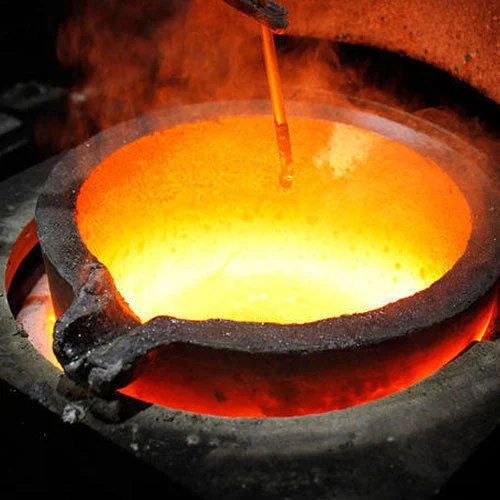
Most enquiries that reach us already specify a process. Often it is the right one. Sometimes the drawing asks for a forging where a casting would be cheaper and just as good, or for a casting on a part that will see reversed bending for twenty years. Getting this wrong is expensive in both directions — in tooling you did not need, or in a component that fails in service.
What follows is how we actually think about the choice: what each process does to the material, where each one runs out of road, and the handful of questions that usually settle it.
Forging: process and principles
What is forging?
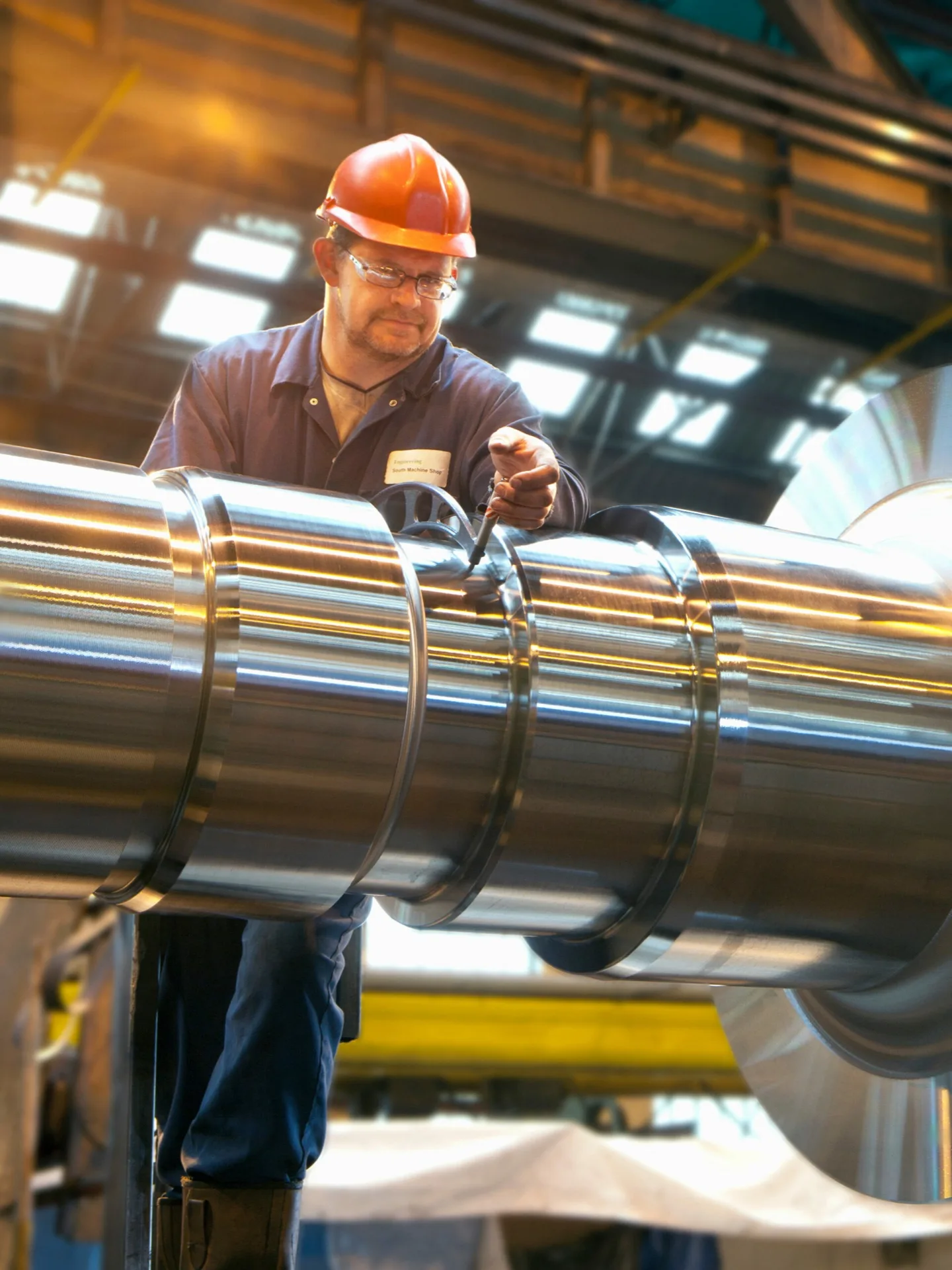
Forging shapes metal by applying compressive force — hammering, pressing or rolling. It can be done hot (above the recrystallisation temperature) or cold; hot forging is the norm for large industrial components.
Two main methods
- Open-die forging: The metal is compressed between flat or simply shaped dies and allowed to flow freely. Ideal for large, simple shapes such as shafts, rings and blocks.
- Closed-die forging: The metal is compressed inside a die cavity that defines the final geometry. Better for complex shapes and tighter tolerances, but the tooling is expensive.
Grain flow, and why it decides most arguments
Forging does not just change the shape of the steel, it changes the internal structure. The grain follows the contour of the part rather than running straight through it, the way grain follows the shape of a branch in timber. Loads that run along that grain are carried well. This is the reason a forged crankshaft outlives a cast one, and it is usually the single argument that decides a rotating or cyclically loaded part.
A macro-etch on a section cut is how you check it. If the flow has been cut through by machining — for instance by turning a flange out of a solid block instead of upsetting it — you have paid for forged material and thrown away most of what you paid for.
Advantages of forging
✓ Higher ductility and toughness
Tensile strength is set mostly by the alloy and the heat treatment, so a good casting can match a forging there. The gap shows up in elongation, reduction of area and notch toughness, where the worked structure of a forging is consistently better.
✓ Excellent fatigue life
Aligned grain flow markedly improves fatigue resistance — critical for rotating machinery, high-cycle applications and safety-critical components.
✓ Impact toughness
Better resistance to shock and impact loading, which is what makes forged parts suit heavy industrial duty.
✓ Sounder material
Hot working closes the shrinkage porosity and gas cavities left over from the ingot. It does not make a forging defect-free — laps, bursts and segregation all exist — but the defect population is smaller and easier to find by ultrasonic testing.
Limitations of forging
- Shape complexity: Complex internal geometries, undercuts and intricate external features are hard to achieve
- Size constraints: Open-die forging is limited by press capacity, closed-die by die size and cost
- Tooling costs: Closed-die forging needs expensive dies, which rules it out at low volumes
- Material usage: Generally more machining stock, and so more material removed
- Lead times: Die manufacture for closed-die forging takes 8 to 16 weeks
Casting: process and principles
What is casting?
Casting pours molten metal into a mould cavity and lets it solidify into shape. Because the metal arrives as a liquid, geometry costs almost nothing: internal passages, cored cavities, changing wall sections and undercuts are all routine. What you give up is the grain structure, and you take on solidification as a variable to be controlled.
Common casting methods
- Sand casting: The most versatile and economical route for large parts. The mould is built from packed sand around a pattern.
- Investment casting (lost wax): Excellent for complex geometries with tight tolerances and a good surface finish.
- Die casting: High-volume production of smaller parts with very good dimensional consistency.
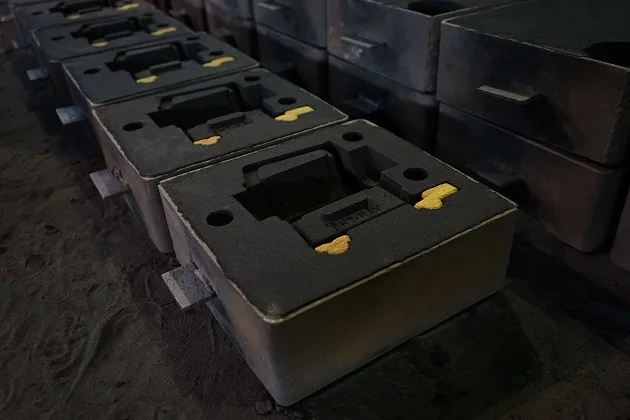
A sand mould ready for pouring. The mould is destroyed to release the casting.
Advantages of casting
✓ Complex geometries
Internal passages, undercuts and intricate external shapes that cannot be forged.
✓ Near-net shape
Closer to final dimensions, which reduces machining and material loss.
✓ Size flexibility
The process itself scales from a few kilograms to well over 100 tonnes; in practice the limit is the foundry's melting, handling and crane capacity. Through our network we source sand castings up to 35 tonnes, and to 80 tonnes in exceptional cases.
✓ Economical for complexity
For intricate shapes, casting is often cheaper than forging plus extensive machining.
Limitations of casting
- Porosity risk: Trapped gas can create internal voids and weaken the section
- Lower properties: Random grain structure and possible defects reduce mechanical properties
- Fatigue performance: Significantly shorter life under cyclic load than a forging
- Surface finish: Sand castings need more surface work; only investment casting gives a smooth finish
- Shrinkage: Contraction during solidification can cause dimensional variation or cracking
Head to head on the factors that matter
Material properties compared
| Property | Forging | Casting | Advantage |
|---|---|---|---|
| Tensile strength | 850–1400 MPa (typical) | 700–1100 MPa (typical) | Forging +15–20% |
| Fatigue life (cycles) | 10⁷ – 10⁸ | 10⁵ – 10⁶ | Forging 10–100× better |
| Impact toughness | Excellent | Moderate to good | Forging significantly better |
| Grain structure | Aligned, directional | Random, isotropic | Forging along load paths |
| Internal soundness | Dense, no porosity | May show minor porosity | Forging more consistent |
| Ductility | Excellent | Good | Forging slightly better |
Cost considerations
| Factor | Open-die forging | Closed-die forging | Sand casting | Investment casting |
|---|---|---|---|---|
| Tooling cost | Low (€0–5k) | High (€20–200k) | Low–moderate (€2–20k) | Moderate (€5–50k) |
| Unit cost (small qty) | Moderate | High | Moderate | Moderate–high |
| Unit cost (high qty) | Moderate | Low–moderate | Low–moderate | Moderate |
| Machining required | Significant | Moderate | Moderate | Minimal |
| Material waste | Higher | Moderate | Lower | Low |
| Break-even volume | 1–10 pieces | 50–500 pieces | 5–50 pieces | 10–100 pieces |
Cost insight
For simple shapes such as shafts and rings in small quantities (1–20 pieces), open-die forging is usually the most economical. For complex shapes, casting becomes competitive. Closed-die forging makes sense at higher volumes (100+) of moderately complex parts, where the better properties justify the tooling investment.
Lead time and production
| Aspect | Forging | Casting |
|---|---|---|
| Tooling lead time | 8–16 weeks (closed-die) / immediate (open-die) | 4–10 weeks (pattern + mould) |
| First article | 10–14 weeks (closed-die) / 4–8 weeks (open-die) | 8–12 weeks |
| Production rate | Slower (labour intensive) | Faster (multiple moulds) |
| Minimum order quantity | 1 piece (open-die) / 25–100 pieces (closed-die) | 1–10 pieces typical |
When to forge and when to cast
Choose forging when:
High-cycle fatigue
Examples: Crankshafts, connecting rods, gears, turbine shafts
Why: Forged grain flow dramatically improves fatigue life (10–100× over casting)
Maximum strength required
Examples: Lifting hooks, pressure vessel components, aerospace parts
Why: Higher properties and markedly better impact toughness
Impact loading
Examples: Hammer components, crusher parts, impact tools
Why: High notch toughness prevents brittle failure
Safety-critical components
Examples: Nuclear components, wellhead equipment, landing gear
Why: Predictable, consistent properties with no internal defects
Simple to moderate geometry
Examples: Shafts, flanges, rings, discs, blocks
Why: Economical for these shapes, especially at low to moderate volume
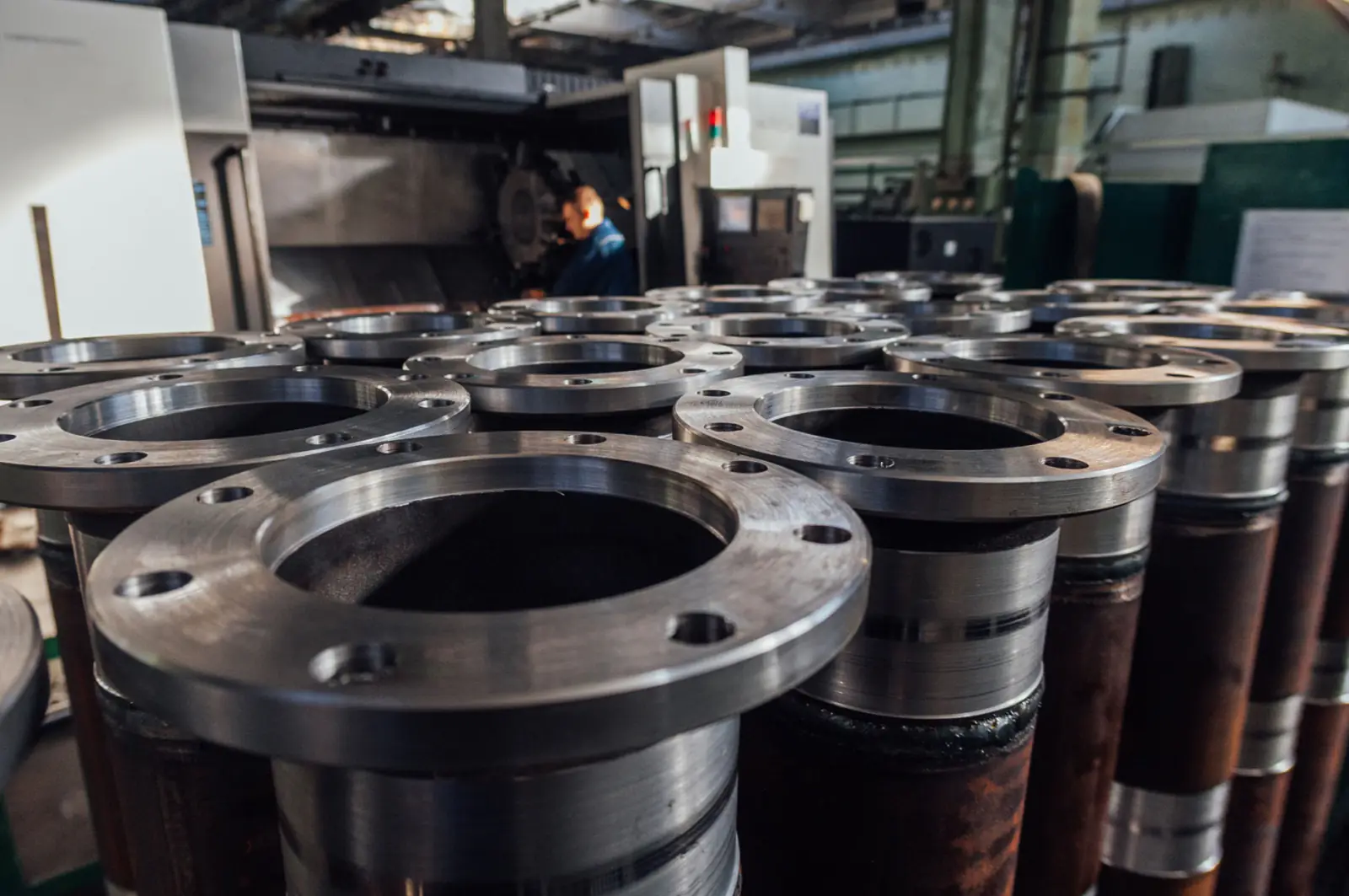
Forged flanges awaiting machining — typical open-die and closed-die output.
Choose casting when:
Complex internal passages
Examples: Valve bodies, pump housings, manifolds
Why: Cooling channels and fluid passages cannot be forged
Intricate external geometry
Examples: Complex brackets, housings with mounting features
Why: Near-net shape removes expensive machining operations
Very large components
Examples: Large valve bodies (>2 m), machine bases, structural castings
Why: Little size limit in sand casting; forging presses have capacity limits
Cost-driven projects
Examples: General industrial housings, non-critical structural parts
Why: Cheaper for complex shapes, and the properties suit many applications
Moderate strength requirements
Examples: Enclosures, covers, non-structural components
Why: Cast properties are sufficient; no reason to pay the forging premium
Cast components. Casting handles internal passages and complex geometry that forging cannot.
The hybrid approach
Sometimes the best answer combines both: a cast body with forged critical inserts. A cast valve body (complex internal passages) with a forged stem (fatigue and wear resistance), for example. That keeps performance high and cost under control.
Large industrial pumps often use cast housings with forged shafts and impellers, combining the geometric freedom of casting with the fatigue resistance rotating components need.
How material choice affects the decision
Not every material suits both processes equally. Material selection can settle the process question on its own:
Forging-favourable materials
- Carbon steels (C45, C60): Excellent forgeability, work harden well
- Alloy steels (42CrMo4, 34CrNiMo6): Respond very well to forging and heat treatment
- Stainless 1.4401 / 1.4301: Forgeable but more demanding; needs higher temperatures
- Titanium alloys: Forging preferred to achieve the optimal microstructure
Casting-favourable materials
- Grey iron EN-GJL: Cannot be forged; excellent castability and damping
- Ductile iron EN-GJS: Cast only; good strength and ductility for many applications
- Aluminium alloys: Many alloys are designed specifically for casting
- Bronze and brass: Traditionally cast; excellent corrosion resistance
Materials suitable for both
- Carbon steel: Decide on geometry, strength and cost
- Stainless steel (1.4301, 1.4401): Both possible; forging gives better properties
- Some aluminium alloys: 6061 and 7075 can be forged; casting alloys are different
Quality assurance and testing
Forging quality checks
Ultrasonic testing (UT)
Detects internal discontinuities, laminations and inclusions. Critical for high-stress applications.
Grain flow inspection
Macro-etching reveals the grain flow pattern and confirms forging orientation and process control.
Mechanical testing
Tensile, hardness and impact testing verify heat treatment and properties.
Dimensional inspection
Forgings need more machining allowance; incoming inspection confirms it is there.
Casting quality checks
Radiographic testing (RT)
X-ray reveals internal porosity, shrinkage cavities and inclusions.
Pressure testing
Hydrostatic or pneumatic testing for castings that contain fluids or gases.
Dye penetrant testing
Surface crack detection before and after machining.
Dimensional verification
Castings are closer to net shape; critical dimensions and tolerances are verified.
Inspection before release. Both forgings and castings are verified against the agreed test plan.
How INTEG handles quality
Every component sourced through INTEG is inspected regardless of manufacturing method. We coordinate works testing, third-party verification where required, and supply complete documentation including material certificates, test reports and dimensional records.
Decision framework
A step-by-step process
Analyse the loading
- Cyclic fatigue? → forging strongly preferred
- Static load only? → either method works
- Impact loads? → forging preferred
- Light duty? → casting usually sufficient
Evaluate geometry
- Simple shape (shaft, ring, disc)? → forging likely more economical
- Complex external features? → casting has the advantage
- Internal passages? → must be cast
- Very large? → casting may be the only option
Consider volume
- 1–10 pieces? → open-die forging or sand casting
- 25–100 pieces? → evaluate tooling cost for closed-die or investment casting
- 500+ pieces? → closed-die forging or die casting become economical
Assess quality requirements
- Safety-critical or code-compliant? → forging gives more predictable properties
- Non-critical application? → casting is adequate and cheaper
- Porosity unacceptable? → forging has the edge
Factor in lead time and budget
- Need parts quickly? → open-die forging or sand casting (no tooling time)
- Tight budget? → compare total cost including machining
- Can amortise tooling over volume? → closed-die or investment casting
A working rule of thumb
If the part is loaded cyclically, carries a shaft or a bolted joint under pressure, or would put somebody in danger when it fails, forge it. If the value of the part is in its shape — internal passages, cored cavities, thin changing walls — cast it, and design the solidification so the loaded sections feed last. Everything else comes down to quantity and to how much machining each route leaves you.
Two things are worth checking before the decision is locked. First, whether cast iron is on the table: it cannot be forged, so if EN-GJS is acceptable the argument is already over. Second, the machining bill. A near-net casting that needs three setups can easily beat a cheap forged block that needs eight, and the raw part price will tell you none of that.
Send us the drawing
We buy both processes and have no stake in which one you pick. If you send the drawing and the duty — loads, cycles, medium, pressure, quantity — we will tell you which route we would quote and why, including the cases where we think the specified process is the wrong one.
Send us your enquiry