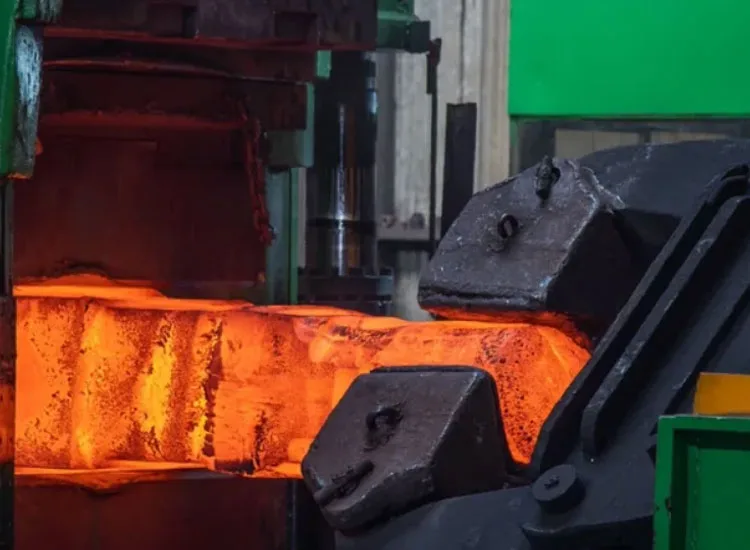
A forged or cast component is not really bought at the price on the invoice. It is bought at that price plus whatever it costs you when three pieces out of fifty fail inspection, when the delivery slips four weeks into your assembly window, or when a housing cracks in the field two years later. Those costs land in different budgets from the purchase price, which is exactly why they are so easy to overlook at the point of decision.
This is how we look at a sourcing decision after fifty years of buying these parts: what to check before a supplier gets an order, how Europe and Asia actually compare once everything is counted, and where the money usually is.
The hidden cost of buying on price alone
Many procurement decisions look only at unit price. The real cost of a component includes considerably more than what appears on the invoice.
Total cost of ownership: the real proportions
| Cost factor | Typical impact | Often overlooked? |
|---|---|---|
| Unit purchase price | 40–60% of total cost | No — everyone sees this |
| Quality failures and rework | 5–15% added cost | Yes — frequently missed |
| Expedited shipping | 2–10% added cost | Yes — in emergencies |
| Inspection and incoming checks | 3–8% added cost | Yes — risk mitigation |
| Production downtime | 10–25% potential loss | Yes — when deliveries fail |
| Warranty and customer impact | Variable, can be large | Yes — field failures |
A worked example
The figures below are illustrative rather than a specific customer, but the shape of the problem is one we see regularly. Take a batch of 50 castings bought at 30% below the going rate, so €15,000 saved against the price on the purchase order. Then count what an unqualified supplier typically costs on top:
- Three pieces rejected for porosity — replacement parts
- Delivery slips past the assembly slot — line standing time
- Air freight to recover the schedule
- Additional incoming inspection on every subsequent batch
- Engineering hours spent on the failure investigation
On a €50,000 order it does not take much of that list to erase €15,000. The point is not the exact numbers, which vary with the part and the plant. It is that every item on the list is charged to a different budget than the one that booked the saving, so the saving looks real right up until somebody adds it all together.
What strategic sourcing does differently
Strategic sourcing evaluates suppliers as a whole: quality system, delivery reliability, technical capability and total cost. The result is often counter-intuitive — paying slightly more per unit while the total programme cost falls.
The five pillars we work to
Over fifty years a way of working has settled out that reduces cost while holding or improving quality. Here is how it works:
Rigorous supplier qualification
Not all suppliers are equal. Before a supplier enters our network, they go through:
- Factory audit: On-site assessment of facilities, equipment and processes
- Quality system verification: ISO certifications, process controls, testing capability
- Technical capability: Can they actually produce what you need?
- Financial stability: Will they still be there next year?
- References: What do their other customers say?
Result: Our network of 30+ suppliers is made up of factories we trust with our own reputation.
Matching part to supplier
The right supplier for the right part. Not every supplier suits every project:
- Specialisation: Component type has to match supplier expertise
- Volume: Small-batch specialists versus high-volume producers
- Technical complexity: Demanding parts need the capability to match
- Geography: Europe for complexity and speed, Asia for volume and value
- Material expertise: Some suppliers excel with particular alloys or processes
Result: Each project goes to the supplier best equipped to execute it.
Preventive quality assurance
Prevent problems rather than catch them. Quality starts before production does:
- Material verification: Mill certificates, chemical analysis, traceability
- First article inspection: Dimensional, mechanical and metallurgical verification
- In-process monitoring: Critical checkpoints during manufacturing
- Final inspection: Complete testing before shipment
- Documentation: Full traceability and certification packages
Result: Issues are caught early, while they are still cheap to fix.
Transparent communication
You always know where your project stands. No surprises, no guessing:
- Single point of contact: One person at INTEG runs your project throughout
- Regular updates: We come to you rather than waiting to be asked
- Issue resolution: Problems addressed immediately with corrective action
- Schedule management: Realistic timelines with buffer for contingencies
- Technical support: Engineering help where it is needed
Result: You know your components will arrive on time and to specification.
Continuous improvement
Getting better together over time. The relationship does not end at delivery:
- Performance tracking: Supplier scorecards on quality, delivery and cost
- Process optimisation: Opportunities to improve and reduce cost
- Design feedback: Manufacturability input to make parts easier to produce
- Volume leverage: Better pricing as the relationship grows
- Knowledge building: A deeper understanding of your needs over time
Result: Year-on-year improvement in cost, quality and service.
Europe or Asia: the geographic decision
One of the most common procurement questions is whether to source from Europe or Asia. There is no single answer — it depends on your specific requirements.
What argues for Europe
Technical complexity and precision
When Europe: Complex geometries, tight tolerances, specialised materials
Why: European manufacturers often have advanced equipment, deep technical expertise and experience with demanding specifications. German, Italian and Eastern European suppliers are strong on precision components.
Speed
When Europe: Short lead times, rapid prototyping, urgent requirements
Why: Proximity means faster shipping (days rather than weeks), easier site visits and better communication across similar time zones. No customs delays within the EU.
Certification and compliance
When Europe: Nuclear, aerospace, pressure equipment directive (PED), ATEX
Why: European suppliers know the EU regulations and usually already hold the necessary certificates. Documentation and traceability systems are mature.
Small batches
When Europe: Quantities under 50 pieces, prototypes, development components
Why: Many European suppliers are set up for small runs and are flexible. Lower minimum order quantities than in Asia.
What argues for Asia
Cost optimisation
When Asia: Cost-sensitive projects, competitive bidding, tight budgets
Why: Lower labour costs and economies of scale deliver 20 to 40% savings on suitable components. Best for standard materials and processes.
Volume production
When Asia: Large runs (100+ pieces), ongoing programmes, stable designs
Why: Asian manufacturers are optimised for volume with efficient workflows. Tooling costs amortise over larger quantities.
Capacity
When Asia: Large components, heavy parts, significant capacity needs
Why: Major infrastructure — large furnaces, heavy presses, extensive machining capacity. Sizes European suppliers cannot handle.
Planned lead time
When Asia: Projects with a three-month horizon, strategic inventory building
Why: When time pressure is not critical, longer lead times become manageable — and are offset by pricing and capacity.
The combination
A portfolio beats the either/or question
Rather than all Europe or all Asia, we help clients build a balanced strategy:
- Critical components: From Europe, for reliability and quality assurance
- Standard components: From Asia, for cost
- Prototypes and development: Europe, for speed and engineering collaboration
- Production volumes: Asia, for cost-effective scale
- Dual sourcing: Critical parts from both regions, for supply chain resilience
Result: Optimised total cost, reduced risk and maximum flexibility.
Europe and Asia at a glance
| Factor | Europe | Asia |
|---|---|---|
| Unit cost | Higher | Lower (20–40% typical saving) |
| Lead time | Shorter (6–10 weeks typical) | Longer (12–16 weeks typical) |
| Technical complexity | Excellent for complex parts | Good for standard designs |
| Minimum order quantity | Lower (1–20 pieces) | Higher (25–100 pieces) |
| Quality consistency | Very high with top suppliers | High with vetted suppliers |
| Communication | Easier (time zone, language) | Requires coordination |
| Freight cost | Lower (road, rail) | Higher (sea, air) |
| Certification | EU compliance standard | Available, but verify carefully |
Where the savings actually come from
A percentage on its own is worth very little — the useful question is which lever produced it, because not all of them apply to every part. There are five we use, and on any given enquiry usually only two or three are available.
1. Volume consolidation and negotiating position
Aggregated demand
By pooling demand from several clients we reach volume pricing individual companies cannot access. A supplier prices 10 pieces differently from 100.
Long-term relationships
Over 50 years of working with the same suppliers means preferred pricing, priority scheduling and flexibility during capacity crunches.
Payment terms
We carry the payment risk and currency management, which lets the supplier price better while you keep your usual terms.
2. Process selection and design for manufacture
The right process
Forging, casting or machining from bar — the manufacturing method moves the cost substantially. We recommend the one that fits your requirement.
Material optimisation
Specifications often call for a premium grade where a standard one would do. We show where there is room, without giving up properties.
Questioning tolerances
Tight tolerances cost money. We work out which dimensions genuinely need precision and where standard tolerances are enough.
3. Removing intermediaries and hidden markups
Traditional procurement chains have several layers, each taking a margin:
| Traditional chain | Markup | Through INTEG | Effect |
|---|---|---|---|
| Factory → local agent | +15–25% | Direct factory relationship | Eliminated |
| Agent → distributor | +10–15% | INTEG as single partner | Eliminated |
| Distributor → you | +20–30% | Transparent pricing | Clear structure |
| Total markup | 45–70% | A single margin | Significant saving |
What we charge for
We charge a fair margin for expertise, quality assurance and project management — but remove several unnecessary layers. The result is a lower total cost than traditional procurement, with considerably more service.
4. Quality that lowers total cost
This sounds contradictory, but it holds: higher quality lowers total cost.
No rework
When parts are right first time, rework, schedule slip and expediting all disappear. One good part beats three cheap ones that fail inspection.
Less inspection burden
Consistent quality from vetted suppliers means less incoming inspection — 'trust but verify' becomes 'verify less often'.
Lower warranty cost
Field failures are orders of magnitude more expensive than factory rejections. Good components reduce claims and protect your customer relationships.
Production continuity
Reliable suppliers mean no stoppages. The cost of a stopped line dwarfs any per-part saving.
5. Stocking blanks instead of ordering finished parts
One of the more effective things we do for recurring components does not look like procurement at all. Instead of ordering the finished part each time it is needed, we buy the blanks in bulk, hold them in stock, and machine them to finish as the orders come in.
A customer buying forged flanges is the clearest example. Rather than ordering flanges, we buy rolled rings in bulk and turn the flanges out of them on demand. Everything slow about the part — the melt, the press slot, the ring rolling, the heat treatment — has already happened and is sitting on a shelf. Only the machining is left, and machining is quick. That took the delivery time for a finished flange from over ten weeks to three and a half.
The price moves in the same direction rather than against it. Rings bought as one bulk order cost materially less per piece than the same parts ordered in ones and twos, because the supplier sets up once, forges from one heat, and puts the whole batch through heat treatment together. On this programme that came to around 8% off the piece price — modest next to the lead time, but it arrives every year rather than once.
The trade-off is inventory: somebody has to own the blanks and the space they occupy. That makes this a good fit where demand is reasonably predictable and the part recurs, and a poor one where the design is still moving. Where the working capital is the obstacle, we can carry the stock ourselves — see our consignment case study.
Managing risk in global sourcing
Cost savings mean nothing if delivery or quality cannot be relied on. Strategic sourcing therefore includes risk management:
Quality risk
Pre-qualification
Thorough vetting before the first order rules out unsuitable suppliers early. We visit the facilities, audit the processes and verify capabilities personally.
Traceability
A complete chain from steel mill to finished part: mill certificates, heat numbers, test reports.
In-process verification
Critical checkpoints during manufacturing catch deviations early. We do not just inspect the finished part, we follow the process.
Third-party testing
Where required, we coordinate independent laboratory testing for mechanical properties, chemical composition and NDT.
Delivery risk
Realistic lead times
We build buffer into schedules based on experience rather than optimistic promises.
Dual sourcing
For critical components we establish two sources — one European, one Asian — as a fallback.
Buffer stock
Where demand is predictable, strategic inventory smooths out supply chain variation.
Logistics partners
Established freight relationships provide reliable shipping, customs clearance and tracking.
Financial and compliance risk
Payment risk
INTEG carries the payment risk towards the supplier. You pay us on standard terms; we manage factory payments and currency exposure.
Regulatory compliance
We make sure suppliers meet the applicable regulations — substance restrictions (RoHS, REACH), safety certification, export control.
Contract management
Clear terms, intellectual property protection and liability provisions protect your interests.
Ongoing monitoring
We track supplier financial health and market conditions, giving early warning before anything reaches your supply.
How getting started works
The INTEG process
Initial consultation (free)
You describe your current situation and requirements. You get:
- A preliminary assessment of the savings potential
- Suitable suppliers from our network
- A rough process and timeline
- No obligation — just an expert view
Technical review
You provide drawings, specifications and requirements. Our team analyses:
- The optimal manufacturing method (forging, casting, machining)
- Material selection and possible optimisations
- Critical dimensions against tolerance opportunities
- Testing and certification requirements
Supplier selection and quotation
We match your project to the best-fit suppliers and obtain quotes:
- Several options (typically European and Asian)
- Transparent pricing breakdown
- Lead time comparison
- Technical assessment of each option
Pilot order and first article
We start with a small batch to prove the process:
- Establish the quality baseline with first article inspection
- Verify lead time and communication
- Confirm pricing and delivery terms
- Validate supplier capability
- A low-risk way to test a new supply chain
Production and continuous improvement
Once validated, we move to regular production:
- Establish ordering patterns and inventory strategy
- Ongoing quality monitoring and supplier scorecarding
- Identify further optimisation opportunities
- Extend the relationship to further components
What we need from you
- Technical drawings: PDF or CAD with dimensions and tolerances
- Material specification: Required grade (e.g. 42CrMo4, C45 to EN 10083)
- Quantity information: Annual volume, batch sizes, order frequency
- Quality requirements: Testing, inspection, certification
- Timeline expectations: When are first parts needed, when are production quantities?
- Current pricing (optional): Helps us benchmark the savings potential
What to expect, and when
| Phase | Duration | Key activities |
|---|---|---|
| Initial consultation | 1 week | Review requirements, preliminary assessment |
| Technical analysis and quotation | 2–3 weeks | Supplier selection, quotation, recommendation |
| First article production | 8–14 weeks | Manufacturing, testing, shipping (varies with complexity) |
| Validation and approval | 1–2 weeks | Dimensional inspection, testing, approval for production |
| Production orders | 6–12 weeks | Ongoing production on the established process |
What this comes down to
Almost everything above reduces to one habit: price the programme, not the part. A supplier who is cheaper per piece and late twice a year is more expensive than one who is not, and the difference never shows up on the line item you were comparing. Qualify before you order, keep at least two sources for anything you cannot afford to wait for, and specify only the testing you will actually act on — every 3.2 certificate you demand out of habit is charged back to you.
Where the geography argument lands depends on the part. Europe tends to win on complex, low-quantity work where the freight and the qualification effort dominate; Asia tends to win on repeat volume where the tooling can be amortised and the schedule has slack in it. Most of our clients end up using both, which is also the cheapest insurance against a single plant going down.
Tell us what you are buying
If you send us a part you are currently sourcing — drawing, annual quantity, and what you pay today — we will tell you whether we think there is room in it, which of the levers above applies, and where in our network we would place it. If we do not think we can improve on what you have, we will say so.
Send us an enquiry+41 44 406 20 00 | info@integag.ch