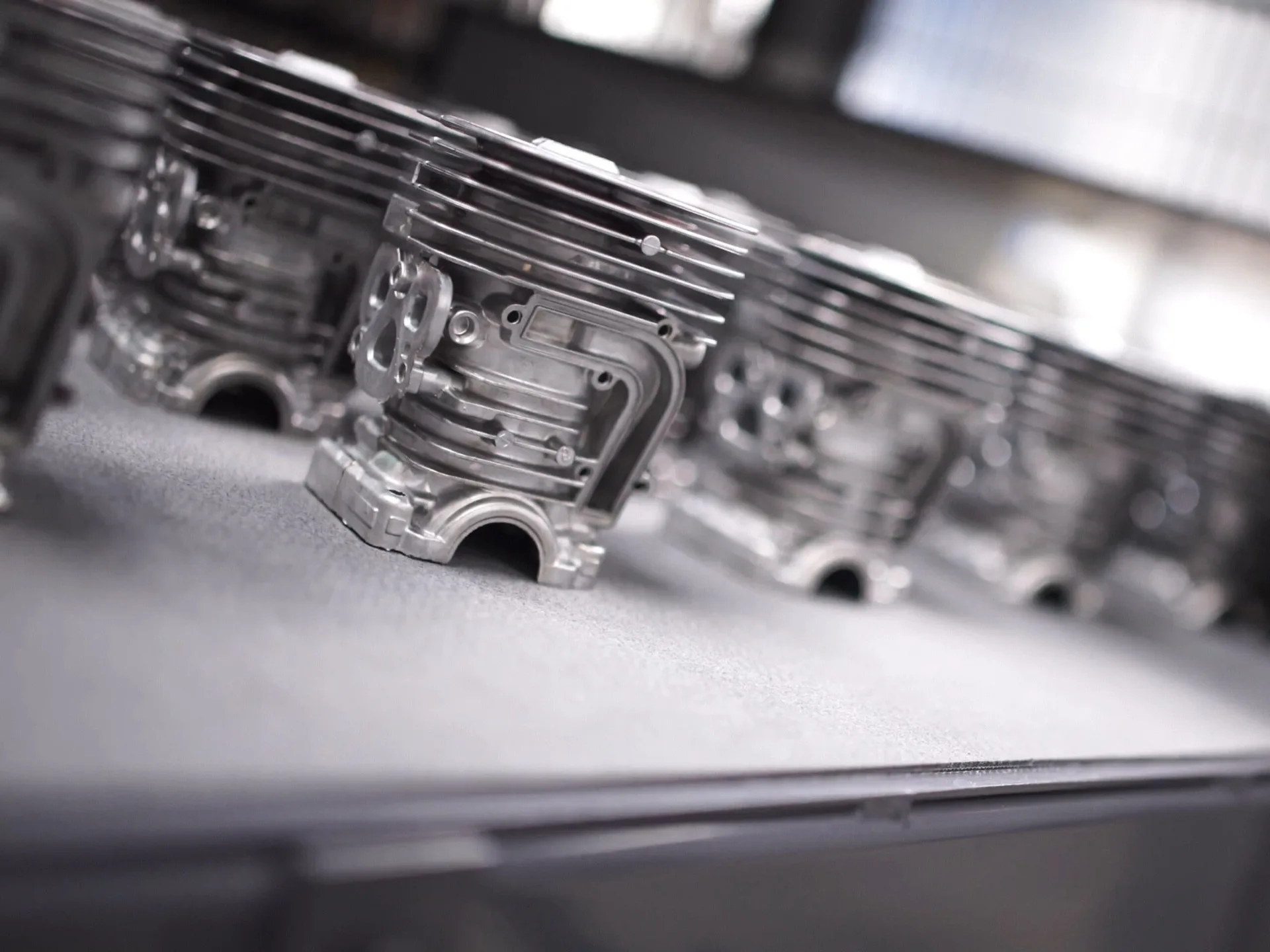
Investment casting, also known as lost-wax casting or precision casting, is a manufacturing process that produces near-net-shape components with exceptional surface finish and dimensional accuracy. Dating back thousands of years (ancient Egyptians used it for jewelry), it has evolved into a sophisticated industrial process for aerospace, medical, and high-precision applications.
In this comprehensive guide, we'll explore the investment casting process, its advantages, limitations, typical applications, and when it's the right choice over sand casting or forging.
What is Investment Casting?
Investment casting creates metal parts by forming a wax or plastic pattern, coating it with a ceramic shell, melting out the pattern (hence 'lost-wax'), and pouring molten metal into the resulting cavity. The ceramic shell is then broken away to reveal the final casting. The term 'investment' comes from the old English use of the word meaning 'to surround' or 'cover'—referring to how the ceramic shell surrounds the wax pattern.
Why Investment Casting?
Investment casting excels where precision, surface finish, and design complexity matter more than piece-price economy. It can produce parts with tolerances as tight as ±0.075mm (±0.003 inches) and surface finishes of Ra 1.6-3.2 µm—far superior to sand casting—while accommodating intricate internal passages, thin walls, and complex geometries that would be impossible or prohibitively expensive to machine.
The Investment Casting Process: 8 Key Steps
The investment casting process is more complex than sand casting but delivers superior results for precision components:
Wax Pattern Creation
Wax (or plastic) patterns are created by injecting molten wax into a metal die (mold). For complex parts, multiple wax components may be assembled into the final pattern. Pattern quality is critical—any defects will appear in the final casting.
Assembly (Tree Building)
Multiple wax patterns are attached to a central wax sprue (gating system) to form a 'tree' or 'cluster.' This allows multiple parts to be cast simultaneously, increasing efficiency. Gates must be positioned to ensure proper metal flow and feeding.
Shell Building (Investing)
The wax tree is repeatedly dipped into ceramic slurry and coated with refractory sand (stucco). Each layer is dried before the next is applied. Typically 5-8 layers are needed to build a shell 5-15mm thick. This creates a strong, heat-resistant mold that can withstand molten metal temperatures.
Dewaxing (Pattern Removal)
The ceramic shell with wax inside is placed in an autoclave or furnace. Heat melts and drains out the wax, leaving a precise hollow cavity inside the ceramic shell. This is the 'lost-wax' step that gives the process its name.
Shell Preheating
The empty ceramic shell is fired at high temperature (900-1100°C) to burn out any residual wax, strengthen the ceramic, and preheat the mold. Preheating prevents thermal shock when molten metal is poured and improves metal flow into thin sections.
Metal Pouring
Molten metal is poured into the preheated ceramic shell immediately after firing. Some foundries use vacuum or centrifugal force to aid metal flow into thin or complex sections. Temperature control is critical—superheating improves fluidity but can cause grain growth or oxidation.
Cooling and Shell Removal
After solidification, the ceramic shell is broken away (knockout) using mechanical vibration, hammering, or water jetting. The castings are then cut from the tree, leaving individual components.
Finishing
Gates and runners are removed (typically by cutting or grinding). Castings may undergo heat treatment, shot blasting (for surface cleaning), and final machining if needed. Because of the excellent as-cast surface and dimensional accuracy, machining requirements are minimal compared to sand castings.
Advantages of Investment Casting
✓ Exceptional Surface Finish
As-cast surface finish of Ra 1.6-3.2 µm (63-125 µin)—often eliminating or drastically reducing machining. Parts can be cosmetically acceptable straight from casting, crucial for medical implants or visible components.
✓ Tight Dimensional Tolerances
Typical tolerances ±0.075-0.125mm per 25mm (±0.003-0.005 inches per inch). This precision reduces or eliminates post-casting machining, saving cost and time. Critical dimensions can be held even tighter with process control.
✓ Complex Geometries
Can produce parts with undercuts, internal passages, thin walls (down to 0.5mm), and intricate details impossible in other processes. Eliminates multi-piece assemblies and welding—cast integral features like brackets, bosses, and flanges in one piece.
✓ Near-Net-Shape
Minimal material waste compared to machining from solid stock. Parts require little or no machining—reducing material costs, cycle time, and scrap. Particularly valuable for expensive alloys like titanium or Inconel.
✓ Wide Material Range
Accommodates virtually any metal: carbon steel, stainless steel, tool steel, aluminum, titanium, cobalt-chromium, superalloys (Inconel, Hastelloy), and even precious metals. Material properties identical to wrought equivalents.
✓ No Parting Line
Unlike sand casting or die casting, investment casting produces parts without a parting line (mold split line), eliminating flash and improving aesthetics and dimensional consistency.
Limitations and Challenges
Despite its advantages, investment casting has constraints that must be evaluated:
- Higher Cost per Piece: More expensive than sand casting due to labor-intensive shell building, wax pattern costs, and longer cycle times. Economics favor medium to high production volumes (typically 100+ pieces).
- Size Limitations: Practical size limit typically 0.5-75kg per casting (though larger parts up to 250kg are possible). Shell building becomes impractical for very large components.
- Longer Lead Times: Shell building and dewaxing take time. Initial tooling (wax injection dies) requires 6-12 weeks. Production runs take 2-4 weeks depending on complexity and volume.
- Brittle Shell Handling: Ceramic shells are fragile and can crack or chip during handling, causing scrap. Requires careful process control and skilled labor.
- Pattern Tooling Investment: Wax injection dies (tooling) can cost $5,000-$50,000 depending on part complexity. This front-end investment must be amortized over production volumes.
Investment Casting vs. Sand Casting
| Feature | Investment Casting | Sand Casting |
|---|---|---|
| Surface Finish | Ra 1.6-3.2 µm (Excellent) | Ra 6-25 µm (Rough) |
| Dimensional Tolerance | ±0.075-0.125mm (Tight) | ±0.5-5mm (Loose) |
| Complexity | Very High - intricate details, thin walls | Moderate - limited by draft angles |
| Cost per Piece | $ - Higher (medium to high volume) | $ - Lower (especially high volume) |
| Size Range | 0.01-75kg typical | 0.1kg - 200+ tons |
| Best For | Precision, complex geometry, finish critical | Large parts, high volume, cost-driven |
Industries and Applications
Investment casting serves industries where precision, performance, and reliability are paramount:
| Industry | Typical Components | Common Materials |
|---|---|---|
| Aerospace | Turbine blades, structural brackets, fuel system components, fasteners | Inconel, Hastelloy, Titanium, 17-4 PH, A286 |
| Medical | Orthopedic implants, surgical instruments, dental appliances, prosthetics | Cobalt-Chromium, Titanium, 316L Stainless Steel |
| Oil & Gas | Valve bodies, pump impellers, wellhead components, high-pressure fittings | Duplex SS, 316/316L, Monel, Inconel 625 |
| Automotive | Turbocharger housings, transmission parts, steering components | Stainless Steel, Tool Steel, Aluminum, Ductile Iron |
| Industrial Machinery | Wear parts, complex brackets, precision gears, tooling components | Tool Steel (H13, D2), Stainless Steel, Aluminum Bronze |
Materials for Investment Casting
Investment casting accommodates an exceptionally wide range of alloys, from common steels to exotic superalloys:
Carbon and Alloy Steel
Carbon steel (1020, 1045, 8620) and alloy steel provide cost-effective strength. Used for industrial components, tooling, and machinery parts where high precision is needed but corrosion resistance isn't critical.
Stainless Steel
Austenitic (304, 316, 316L), martensitic (410, 17-4 PH), and duplex grades offer corrosion resistance. Widely used in oil & gas, food processing, and marine applications. 17-4 PH provides high strength with good corrosion resistance.
Nickel-Based Superalloys
Inconel (625, 718, X-750), Hastelloy, and Waspaloy withstand extreme temperatures and corrosive environments. Essential for aerospace (turbine blades, combustion chambers) and chemical processing. Investment casting is often the only economical way to produce these complex superalloy parts.
Aluminum and Titanium
Aluminum alloys (A356, 356, 2024) for lightweight aerospace and automotive parts. Titanium (Grade 2, Grade 5/Ti-6Al-4V) for medical implants, aerospace, and high-performance applications where strength-to-weight ratio is critical.
Design Considerations for Investment Casting
To maximize the benefits of investment casting, designers should consider:
Wall Thickness
Maintain uniform wall thickness where possible (typically 1.5-6mm). Avoid thick sections that cause shrinkage porosity. Minimum wall thickness: 0.5mm (aluminum) to 1.5mm (steel).
Draft Angles
Unlike sand casting, investment casting requires minimal draft (0.5-1°) for wax pattern removal from dies. This allows nearly vertical walls and more design freedom.
Radii and Fillets
Use generous fillets (minimum 0.5mm radius) at all corners and junctions to reduce stress concentrations and improve metal flow. Sharp corners increase the risk of hot tearing.
Holes and Passages
Holes and internal passages can be cored directly into the casting. Minimum hole diameter typically 1.5mm. Complex internal geometries (cooling passages, manifolds) can be cast integrally, eliminating drilling or EDM.
Conclusion: When to Choose Investment Casting
Investment casting is the process of choice when surface finish, dimensional accuracy, and geometric complexity are critical—and when the higher cost per piece is justified by reduced machining, material savings, or functional performance. It bridges the gap between sand casting (economical but rough) and precision machining (accurate but expensive and wasteful).
Key Takeaways
- ✓ Investment casting delivers Ra 1.6-3.2 µm surface finish and ±0.075mm tolerances—far superior to sand casting
- ✓ Ideal for complex geometries, thin walls, internal passages, and near-net-shape components
- ✓ Best suited for medium to high production volumes (100+ pieces) due to higher piece-cost
- ✓ Essential for aerospace, medical, and high-performance applications using superalloys, titanium, or stainless steel
- ✓ Design for manufacturability: uniform wall thickness, generous fillets, and appropriate tooling access
Need Precision Casting Expertise?
INTEG partners with certified investment casting foundries specializing in aerospace, medical, and industrial precision components. Our technical team can guide you through material selection, design optimization, and supplier qualification to ensure your components meet the highest quality standards.
Discuss Your Precision Casting Needs